From chart recorders to cGMP devices: A career in purification
Published date: 05 March 2026
By Ian Scanlon, Lead Fiber Development R&D, Astrea Bioseparations
“I make tools to purify medicines.”
It is still the simplest way to describe a career that has moved from persuading small molecules to crystallize to developing advanced adsorbent materials for modern bioprocessing.
Today, that means working on new adsorbents and helping customers implement them effectively. Chromatography is a core focus, but the real job is broader: understanding how purification tools behave in the wider reality of therapeutic manufacturing, from early development through to scaled production.
Like many careers in purification, it did not begin with a grand plan.
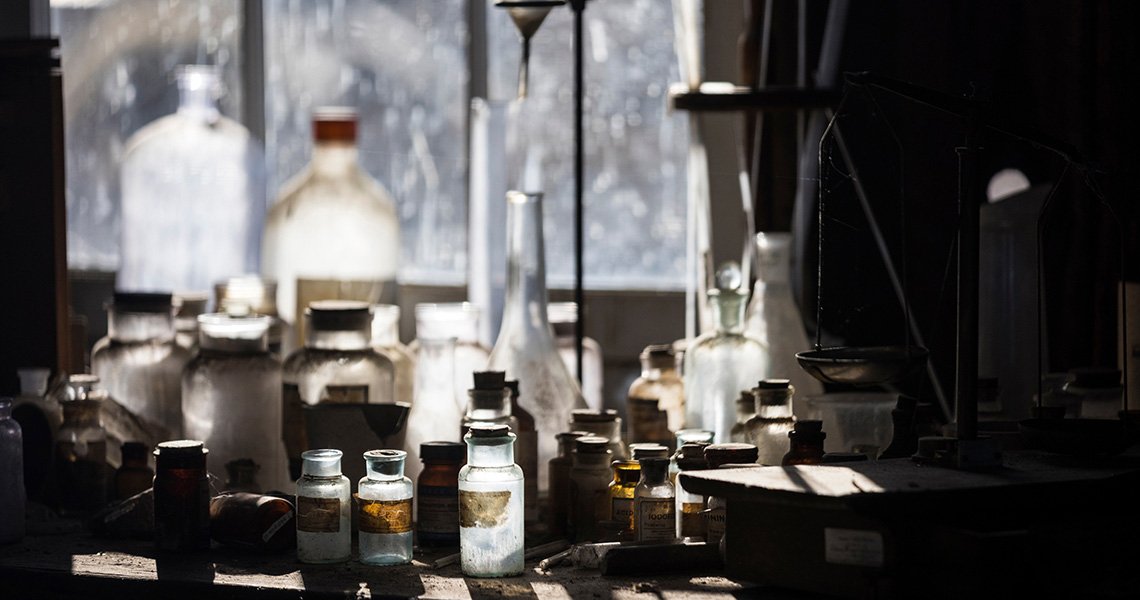
The room with the window
In the dog days of the last century, the only room in the lab with a window housed the chromatography system. No one else wanted to pack the Soviet-era dynamic axial compression column. It was temperamental, physical, and required patience, and that was reason enough.
Packing columns seemed preferable to spending days coaxing reluctant small molecules into crystallizing. There was something quietly satisfying about watching the chart recorder trace its way across the page, collecting fractions, and glancing outside at birds in the trees and foxes in the chalk pit by the car park. The whole setting felt faintly like a 1970s Doctor Who episode.
What began as opportunism became curiosity. Because purification, at its heart, feels like a magic trick.
Take 200 liters of brown goop, send it behind the curtain of a process train. Out comes a purified therapeutic that will treat a human being rather than just stain their clothes.
An undergraduate sublimation experiment made that lesson permanent. Using a liquid nitrogen cold finger, a synthetic painkiller emerged in crisp crystals from what looked like the top of a crème brûlée. The theatrical part was memorable, but the discussion afterwards mattered more. The impurities in the starting material were not trivial, but the difference between crude and pure is not academic. It’s the difference between safe and unsafe, which really brings the importance of purification home to you.
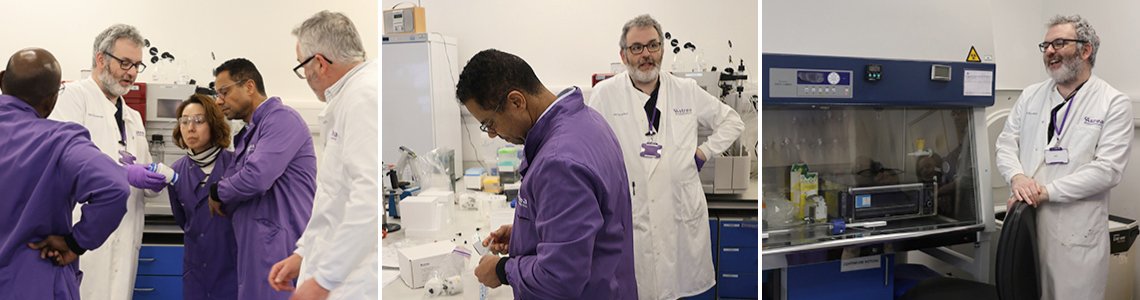
A shift in perspective
For much of an early career in small molecule drug discovery, chromatography was something to engineer out if possible, because it added cost and complexity. The elegant solution was selective chemistry and clean crystallization.
That perspective shifted in 2008.
A new role supporting consumables for one of the first Illumina DNA sequencing platforms demanded rapid, scalable purification of dye-conjugated phosphate species. Straightforward on paper, less straightforward at scale.
The process began with extremely expensive preparative HPLC columns and evolved into more scalable ion exchange and reverse phase workflows. As sequencing expanded globally, purification had to keep pace.
Chromatography was no longer something to remove… It was something to engineer up.
That turning point opened the door to bioprocessing more broadly: flow filtration, large-scale protein purification, nucleic acid isolation. A new toolbox, and a new appreciation for what scale really means.
The reality of scale
Bench-top solutions can look elegant and effective. But purification decisions must survive contact with a 2000 L skid and a team in hard hats being able to easily implement your solution.
Scalability changes everything.
Increasing adsorbent capacity may reduce column size, but that can affect flow characteristics and process timing. Increasing flow rate capability might require new hardware. Improvements on paper can create unintended consequences in installation, waste handling, operator time, or change control burden.
For process development scientists, the cost of change, FTE time, scalability, and waste management often matter more than incremental performance gains. A solution only works if it works in the whole system, otherwise, you’re just missing pieces of the puzzle.
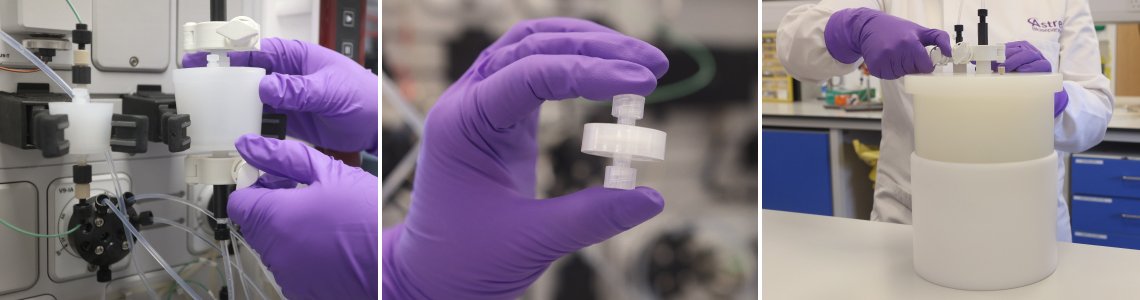
From concept to cGMP: the AstreAdept® journey
One project that captures this system’s thinking is AstreAdept®.
Taking the material from concept to cGMP-compatible device required chemists, engineers, DSP specialists, and product teams working in tight feedback loops. Iteration was constant.
One deceptively simple challenge was sealing the composite fiber into a filter-style device. It looks like paper, filters are everywhere, surely this would be straightforward.
It was not.
As a composite of two polymers, the material did not behave as expected. Standard sealing approaches did not translate. The solution came from adapting multiple related technologies and building a series of prototypes that included everything from Q-tips to lolly sticks.
Eventually, it worked.
Last year saw the release of the first cGMP-compatible devices incorporating AstreAdept® material, with customers now implementing it into production processes. It is still evolving, but the journey from idea to compliant device is something to be proud of.
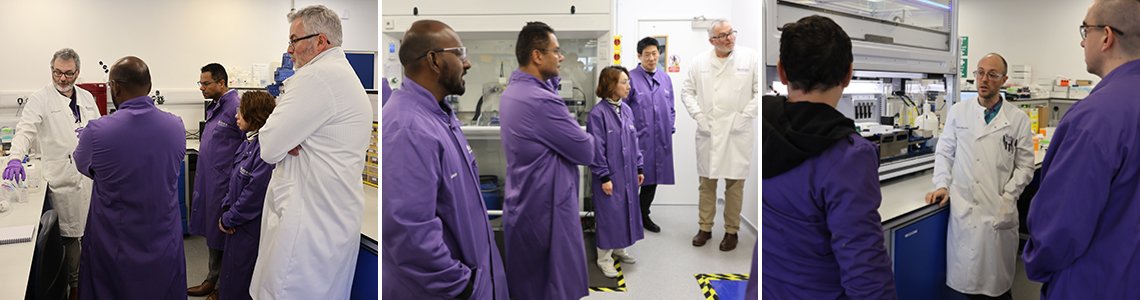
The human side of the lab
From the outside, laboratory work can seem abstract or mechanical. In reality, it is deeply human.
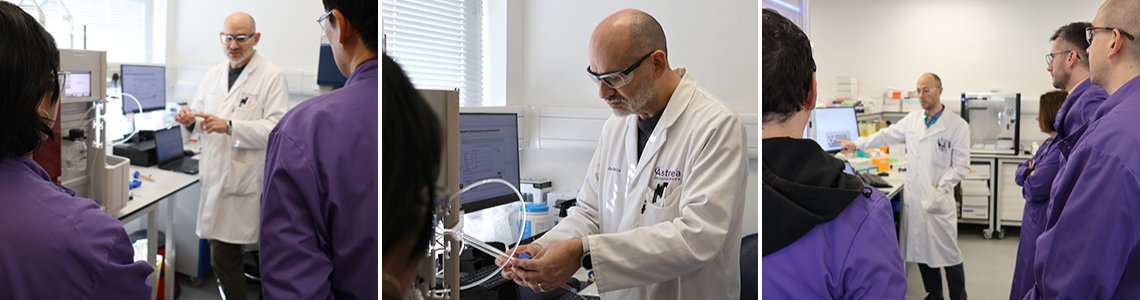
A lab is simply a gathering place for a disparate group of people trying to achieve a common goal, with all the joys and frustrations that it brings. There are fewer dramatic switches on stone walls and fewer stuffed alligators hanging from the ceiling than childhood imagination might have suggested… But there is still something extraordinary about transforming raw biological material into a safe, effective therapeutic.
Staying curious
Curiosity is sustained by the people involved and the possibilities of the tools at hand.
As Karel Čapek observed, “culture depends on how things—any thing—are used”. The same applies to purification technology. Tools are never static. Someone, somewhere, will find a new and interesting way to use them.
The job is to keep listening, to colleagues, to customers, to the data. To listen, acknowledge, and respect that there is a narrative that accompanies every dataset. Skepticism is essential in science, but so is careful attention to the people generating the results, how their story effects interpretation of the numbers and observations.
Because in the end, purification is not just about matrices, columns, or devices, it’s about enabling medicines.
Sometimes, too, it is about choosing the room with the window.
Explore the AstreAdept® family here to see how nanofiber-based purification is opening new possibilities for cell and gene therapy downstream processing.


