
Article Filters

How to choose a chromatography column for each stage of process development

Published date: 02 November 2026

Back to Article Listing

Selecting the right chromatography column isn't simply a question of choosing a particular size or format. The requirements of your chromatography hardware change as your purification process progresses from initial resin screening through process development, characterization, scale-up and ultimately manufacturing.

Choosing column platforms with this progression in mind can make it easier to generate representative process data, transfer methods between scales and establish a clear pathway towards manufacturing.

So, what should you consider at each stage?
Resin screening: Start small and screen efficiently

Early in process development, the objective is typically to compare chromatography media and operating conditions quickly while using minimal sample.

High-throughput screening formats allow multiple resins and process conditions to be evaluated in parallel, helping identify promising purification strategies before moving into larger column formats.

Astrea Bioseparations offers two formats for this stage:

  • MiMode® 96-well Plates provide a simple, high-throughput format for evaluating mixed-mode resins using minimal sample volumes.
  • RoboColumns®, available in 200 µL and 600 µL formats, enable automated screening on liquid handling platforms where greater throughput and reproducibility are required.

These approaches can accelerate resin selection while generating data that can be transferred into larger column formats as development progresses.

Method optimization: Moving into laboratory columns

Once a suitable chromatography resin has been identified, attention turns to optimizing the method.

Parameters such as flow rate, residence time, loading capacity and elution conditions need to be refined to maximise process performance and robustness. At this point, laboratory-scale chromatography columns allow experiments to be performed under representative operating conditions.

SNAP® Columns are available in internal diameters from 10 mm to 50 mm and provide a configurable platform for iterative method development. Quick-release end clamps, graduated bed height markings and replaceable consumable components allow columns to be reconfigured between experiments.

For laboratories looking for a ready-to-use alternative, Evolve®R Columns are available in 10 mm and 25 mm internal diameters as pre-packed research-use columns.

Process characterization: Generating reproducible data

Following method optimization, process characterization is used to demonstrate process robustness and generate data to support regulatory submissions.

This can include robustness assessments, resin lifetime and reuse studies, viral clearance studies and other experiments designed to demonstrate process consistency and performance.

Reproducibility becomes particularly important at this stage.

SNAP® Columns support process characterization through precise bed height adjustment and a configurable design compatible with a wide range of chromatography media.

Evolve®R Columns offer a ready-to-use alternative, reducing the time and variability associated with column packing.

SNAP® Columns are also widely used for viral clearance studies and can be supplied empty for self-packing or pre-packed in Astrea Bioseparations' dedicated cleanrooms with a selected chromatography resin.

Pilot scale and engineering runs: Preparing for manufacturing

Pilot-scale and engineering runs provide the bridge between laboratory development and commercial manufacturing.

Processes are transferred onto process-scale hardware to confirm scalability, evaluate performance under representative operating conditions and generate engineering or clinical manufacturing batches ahead of routine production.

Evolve®S Columns, available in 10 mm and 25 mm internal diameters, provide ready-to-use, cleanroom-manufactured chromatography columns supported by bioburden and endotoxin testing and regulatory documentation. They are suited to engineering studies, process transfer and smaller-scale GMP applications, including emerging cell and gene therapy workflows.

For larger-scale requirements, Evolve®D Columns are available in internal diameters from 70 mm to 600 mm. Their scalable geometry and consistent flow distribution support pilot-scale purification and process transfer, while pre-packed formats eliminate column packing and cleaning before use.

Clinical and commercial manufacturing: Selecting a long-term platform

By the time a process reaches clinical or commercial manufacturing, chromatography hardware must support consistent performance across repeated production campaigns while meeting the requirements of GMP operations and process qualification.

The choice between pre-packed and self-packed hardware can also become an important part of the manufacturing strategy.

Evolve®D pre-packed columns, available in internal diameters up to 600 mm, can be supplied pre-packed with Astrea Bioseparations resins or third-party chromatography resins. Eliminating column packing and cleaning requirements can enable faster deployment into GMP manufacturing.

For manufacturers that prefer to pack their own columns, Evolve® Process Columns provide reusable, large-scale self-packing chromatography platforms. Refresh Kits allow wetted parts to be replaced during routine maintenance, helping support repeated production campaigns.

Think about the journey, not just the next experiment

Chromatography column selection shouldn't necessarily be treated as an isolated decision at each development stage.

Considering future requirements early can provide a clearer pathway through:

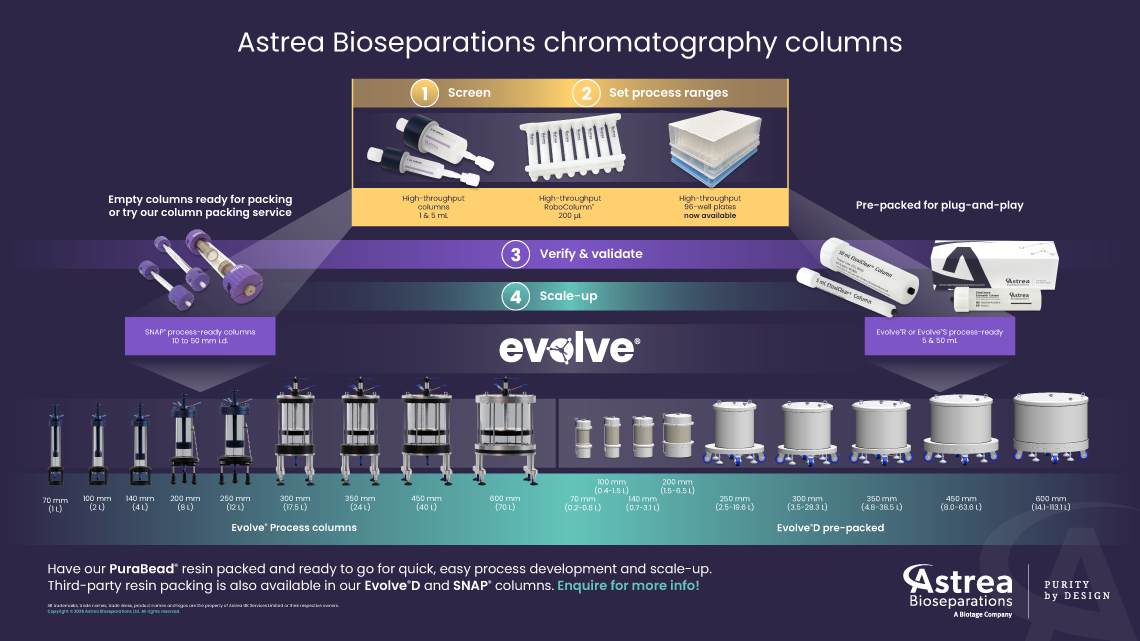
Astrea Bioseparations offers complementary chromatography platforms across these stages, from MiMode® 96-well Plates and RoboColumns® for initial screening through SNAP®, Evolve®R and Evolve®S to process-scale Evolve®D and Evolve® Process Columns. Selecting complementary platforms early in development can support consistent process transfer and provide a clearer route from laboratory studies to routine manufacturing.

Your basket

Your basket is empty. Continue shopping to add products to your basket.

Your quote list

Your quote list is empty. Continue browsing to add products to your quote list.

Search our catalogue

Call Centre

Request Quote

View Content

Please complete the form below to receive the requested content from Astrea Bioseparations. We will use the data you provide to send you relevant updates, special offers, and product-related information. See our Privacy Notice for details on how we use personal data.

If you have an account please log in to gain access to content. You can apply for an account here

Please enter a First Name

Please enter a valid First Name, the maximum length is 50 characters.

Please enter a Last Name

Please enter a valid Last Name, the maximum length is 50 characters.

Please enter a Company Name

Please enter a valid Company, the maximum length is 100 characters

Please enter a valid Email AddressPlease enter a valid Email AddressThe Email Address entered is already registered, please sign in with the Email Address or enter a different one

Please select a valid Telephone Number, the maximum length is 30 characters

Please enter a valid Telephone Number consisting only of the following characters and spaces ( ) + 0 1 2 3 4 5 6 7 8 9

Please select a State / Province / Territory

Please select a valid State / Province / Territory, the maximum length is 150 characters

Please select a Country

Data entered into form will be stored in your session (not in a cookie) to avoid having to re-enter in future form submissions.

How to choose a chromatography column for each stage of process development

Published date: 02 November 2026

Back to Article Listing

Selecting the right chromatography column isn't simply a question of choosing a particular size or format. The requirements of your chromatography hardware change as your purification process progresses from initial resin screening through process development, characterization, scale-up and ultimately manufacturing.

Choosing column platforms with this progression in mind can make it easier to generate representative process data, transfer methods between scales and establish a clear pathway towards manufacturing.

So, what should you consider at each stage?

Resin screening: Start small and screen efficiently

Early in process development, the objective is typically to compare chromatography media and operating conditions quickly while using minimal sample.

High-throughput screening formats allow multiple resins and process conditions to be evaluated in parallel, helping identify promising purification strategies before moving into larger column formats.

Astrea Bioseparations offers two formats for this stage:

  • MiMode® 96-well Plates provide a simple, high-throughput format for evaluating mixed-mode resins using minimal sample volumes.
  • RoboColumns®, available in 200 µL and 600 µL formats, enable automated screening on liquid handling platforms where greater throughput and reproducibility are required.

These approaches can accelerate resin selection while generating data that can be transferred into larger column formats as development progresses.

Method optimization: Moving into laboratory columns

Once a suitable chromatography resin has been identified, attention turns to optimizing the method.

Parameters such as flow rate, residence time, loading capacity and elution conditions need to be refined to maximise process performance and robustness. At this point, laboratory-scale chromatography columns allow experiments to be performed under representative operating conditions.

SNAP® Columns are available in internal diameters from 10 mm to 50 mm and provide a configurable platform for iterative method development. Quick-release end clamps, graduated bed height markings and replaceable consumable components allow columns to be reconfigured between experiments.

For laboratories looking for a ready-to-use alternative, Evolve®R Columns are available in 10 mm and 25 mm internal diameters as pre-packed research-use columns.

Process characterization: Generating reproducible data

Following method optimization, process characterization is used to demonstrate process robustness and generate data to support regulatory submissions.

This can include robustness assessments, resin lifetime and reuse studies, viral clearance studies and other experiments designed to demonstrate process consistency and performance.

Reproducibility becomes particularly important at this stage.

SNAP® Columns support process characterization through precise bed height adjustment and a configurable design compatible with a wide range of chromatography media.

Evolve®R Columns offer a ready-to-use alternative, reducing the time and variability associated with column packing.

SNAP® Columns are also widely used for viral clearance studies and can be supplied empty for self-packing or pre-packed in Astrea Bioseparations' dedicated cleanrooms with a selected chromatography resin.

Pilot scale and engineering runs: Preparing for manufacturing

Pilot-scale and engineering runs provide the bridge between laboratory development and commercial manufacturing.

Processes are transferred onto process-scale hardware to confirm scalability, evaluate performance under representative operating conditions and generate engineering or clinical manufacturing batches ahead of routine production.

Evolve®S Columns, available in 10 mm and 25 mm internal diameters, provide ready-to-use, cleanroom-manufactured chromatography columns supported by bioburden and endotoxin testing and regulatory documentation. They are suited to engineering studies, process transfer and smaller-scale GMP applications, including emerging cell and gene therapy workflows.

For larger-scale requirements, Evolve®D Columns are available in internal diameters from 70 mm to 600 mm. Their scalable geometry and consistent flow distribution support pilot-scale purification and process transfer, while pre-packed formats eliminate column packing and cleaning before use.

Clinical and commercial manufacturing: Selecting a long-term platform

By the time a process reaches clinical or commercial manufacturing, chromatography hardware must support consistent performance across repeated production campaigns while meeting the requirements of GMP operations and process qualification.

The choice between pre-packed and self-packed hardware can also become an important part of the manufacturing strategy.

Evolve®D pre-packed columns, available in internal diameters up to 600 mm, can be supplied pre-packed with Astrea Bioseparations resins or third-party chromatography resins. Eliminating column packing and cleaning requirements can enable faster deployment into GMP manufacturing.

For manufacturers that prefer to pack their own columns, Evolve® Process Columns provide reusable, large-scale self-packing chromatography platforms. Refresh Kits allow wetted parts to be replaced during routine maintenance, helping support repeated production campaigns.

Think about the journey, not just the next experiment

Chromatography column selection shouldn't necessarily be treated as an isolated decision at each development stage.

Considering future requirements early can provide a clearer pathway through:

Astrea Bioseparations offers complementary chromatography platforms across these stages, from MiMode® 96-well Plates and RoboColumns® for initial screening through SNAP®, Evolve®R and Evolve®S to process-scale Evolve®D and Evolve® Process Columns. Selecting complementary platforms early in development can support consistent process transfer and provide a clearer route from laboratory studies to routine manufacturing.

Call Centre Product Compare